
Is User Experience a Fad?
06.17.2025
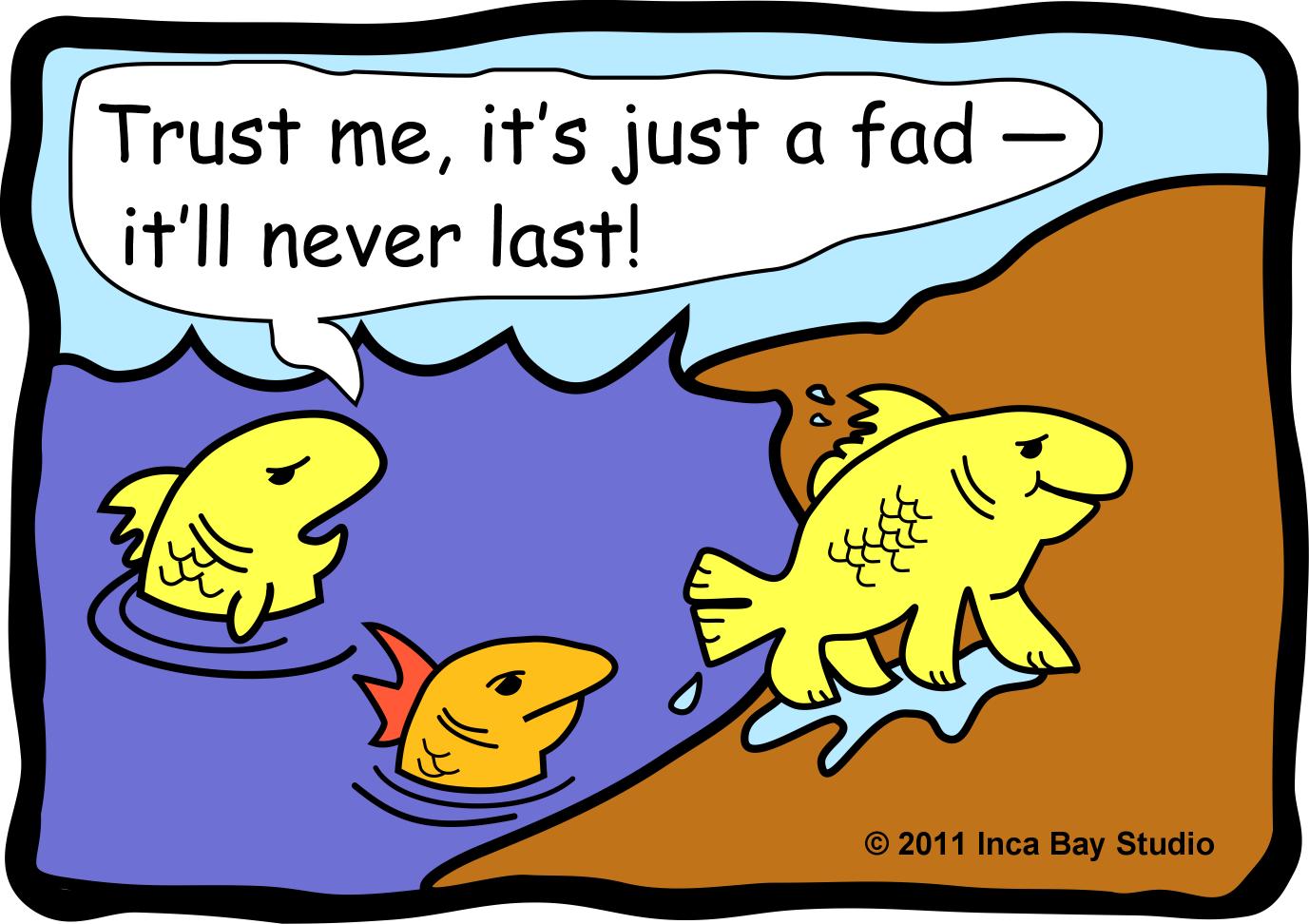
During student introductions at a recent User Experience Foundations class in Boston, an executive announced,
"I’m here to see what this user experience fad is all about."
It wasn’t a hostile comment, but it stuck with me.
The business world has seen plenty of fads come and go. Think Og Mandino’s The Greatest Salesman in the World in the late 1960s and ’70s, or Stephen Covey’s The Seven Habits of Highly Effective People in the 1990s. Occasionally, a new way of thinking emerges that genuinely fills a need. It hits a nerve. And while many of these ideas still have value, far fewer organizations today are spending thousands of dollars per employee on full-blown Seven Habits training.
Back in the late '90s, I got a call from a company that had done exactly that. The owner wasn’t convinced his staff returned from the training as "highly effective people," so he asked me to write a custom application. Its job? Email each employee a "Covey Quip" (random quotes and reminders pulled from the book to reinforce the mindset) every morning at 9 a.m.
I built it. Within a week, most employees had created an Outlook rule to automatically delete the email on arrival. At least they were highly effective with Outlook.
So the Boston executive’s question is a fair one: Is user experience just another business fad? If so, is it already fading? Will User Experience Foundations someday sit on my shelf alongside retired classes on OS/2, Lotus Notes, and Flash?
From Differentiator to Expectation
Fifteen years ago, searching for “user experience” jobs on sites like Dice or LinkedIn produced a modest list. Today, that same search returns tens of thousands of roles globally, spanning UX design, research, service design, content design, product design, and now—AI and conversational experience design.
This didn’t happen by accident.
A handful of influential thinkers (Jakob Nielsen, Don Norman, among others), a few foundational books (The Design of Everyday Things chief among them), and watershed moments (the iPhone’s introduction, the explosion of SaaS, mobile-first design) collectively woke businesses up to a simple truth:
Products don’t just need to work. They need to work for people.
For a solid decade, UX was novel. Designers who understood usability, mental models, and human-centered design could differentiate themselves simply by naming these concepts. UX was a competitive advantage.
UX in 2026: Table Stakes, Not a Trend
Fast forward to 2026, and something important has changed.
User experience is no longer a differentiator.
It’s an expectation.
Organizations now assume that products will be:
- Learnable without training manuals
- Accessible by default
- Consistent across devices
- Designed around real workflows, not org charts
No one brags about "having UX" anymore—just as no company brags about having accounting or quality control. It’s part of the operating system of modern product development.
Does that mean the work is done? Not even close.
Enterprise systems are still infamous for friction, cognitive overload, and poor adoption. But today’s workforce, especially those who grew up with intuitive, well-designed consumer apps, has little tolerance for spending evenings using elegant tools like Airbnb, Spotify, or Notion, only to arrive at work and wrestle with clunky, confusing internal systems.
That pressure has finally reached even the slowest-moving organizations.
The AI Wake-Up Call
If there was any doubt about UX’s permanence, artificial intelligence erased it.
AI has made one thing painfully clear: Without good user experience, powerful technology is useless.
Prompt design, conversation flows, trust, transparency, explainability, error recovery are UX problems. The rise of AI hasn’t replaced UX; it has elevated it. Teams now need to understand not just interfaces, but human judgment, cognitive load, and how people make sense of systems that think with them.
In 2026, terms like personas, journey mapping, usability testing, mental models, accessibility, and ethical design aren’t buzzwords. They’re basic professional vocabulary.
So, Is UX a Fad?
No.
Fads fade. Their books end up on clearance racks and donation shelves.
User experience has done the opposite. It has embedded itself into how modern products are conceived, built, evaluated, and improved. Designers and developers today have access to robust design systems, research frameworks, usability standards, accessibility guidelines, and AI-augmented tools that make human-centered design more achievable than ever before.
UX didn’t disappear.
It became foundational.
And if you somehow missed the UX wave, it’s not too late. The conversation has expanded, not closed.
Do a quick search. Explore the field.
Or better yet, consider joining one of our UX classes!
